
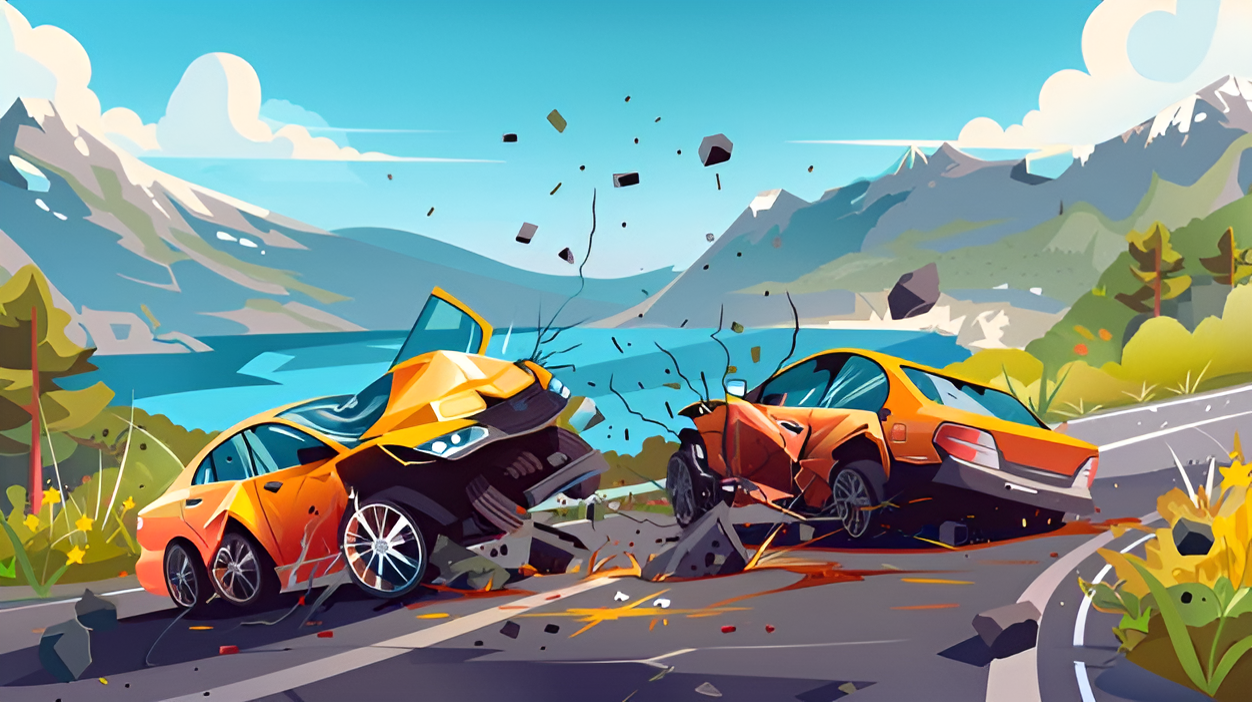
In a motor accident involving a collision between a car and an abandoned trailer truck, the Tribunal and the High Court of Karnataka held that the driver of the car and the driver of the truck were jointly responsible for the accident, and reduced the compensation to the claimants by 50% on account of contributory negligence. The claimants appealed to the Supreme Court challenging the deduction of compensation.
Issues:
The core issue involved in these appeals centres around the deduction of 50% compensation awardable to the appellant claimants, who have assailed the concurrent findings of the Courts below on the aspect of contributory negligence whereby, the driver of the car, who also died in the accident, was held jointly responsible for causing the collision.
Facts:
A car collided with an abandoned 14-wheeler trailer truck. The truck was left in the middle of the highway without any warning signs, indicators, or parking lights. Tragically, the crash resulted in the deaths of the car’s passengers and its driver. Only one passenger, X, survived the accident.
X, along with the legal heirs of the deceased, filed separate claim petitions under Section 166 of the Motor Vehicles Act. They sought compensation from the truck’s owner. Both insurance companies for the truck and the car were included as parties in the petitions. The Tribunal reviewed these claims and determined that both drivers contributed to the accident. It noted that the car’s driver failed to take necessary precautions to avoid hitting the stationary truck. As a result, the Tribunal reduced the compensation by 50% due to the car driver’s contributory negligence. The High Court later upheld this finding regarding contributory negligence.
Approach to Interference in Concurrent Findings:
In the case of State of Rajasthan v. Shiv Dayal1, the Supreme Court clarified the grounds on which a concurrent finding of fact can be challenged in a second appeal. It stated that an appellant has the right to argue that the finding is legally flawed if it was made without reference to the pleadings, lacked supporting evidence, misinterpreted key documentary evidence, violated any legal provisions, or resulted in a conclusion that no reasonable judge could have reached.
In Sukhbiri Devi v. Union of India2, the Supreme Court emphasized the limited scope of interference with concurrent findings of fact in appeals filed under Article 136 of the Constitution. It asserted that such interference should be done sparingly and only in cases where the lower court’s judgment is deemed absolutely perverse. Additionally, the Court clarified that merely presenting an alternative view based on a different appreciation of evidence is insufficient to warrant overturning a plausible conclusion that has been affirmed by both lower courts.
In the landmark case of Bharwada Bhoginbhai Hirjibhai v. State of Gujarat3, the Supreme Court of India outlined key principles for interfering with concurrent findings made by lower courts. A two-Judge Bench established specific circumstances under which such interference is allowed:
| a). Lack of Evidence: The court can intervene if a finding lacks any evidential support. If the conclusion reached has no factual basis, it is subject to challenge. |
| b). Perversion of Justice: Interference is justified when a finding is perverse, meaning no reasonable person could have arrived at that conclusion based on the evidence presented. This criterion ensures that decisions are rational and fair. |
| c). Inadmissible Evidence: If a finding relies on inadmissible evidence, and excluding this evidence would significantly undermine the prosecution’s case, the higher court may correct this error. |
| d). Overlooked Evidence: The court can intervene if a crucial piece of evidence that could influence the outcome has been ignored or improperly discarded by the lower courts. |
Held:
Regarding the Reduction of Claims for Deceased Passengers, the Court Held That:
Based on the observation made in Union of India v. United India Insurance Co. Ltd.,4 it was observed that the deceased driver, should not be deemed jointly responsible for the accident with the truck driver. This led to a 50% deduction in claims for the passengers and dependents, which the court deemed unjust. The principle of contributory negligence should only apply to the actual negligence of the driver, not to passengers. Passengers cannot be held liable for the driver’s actions, as they do not control the vehicle. Therefore, the compensation for passengers and their legal heirs should not be reduced based on the driver’s negligence.
For fastening partial liability on the driver of the car on the basis of contributory negligence in causing the accident:
The High Court confirmed that the offending truck was parked in the middle of the road, a finding that remains unchallenged. The accident occurred on August 18, 2013, which as per the Hindu calendar fell on Shukla Paksha Dwadashi, during a time with no moonlight, meaning the road was pitch dark. There were no references to streetlights at the collision site, making it nearly impossible for drivers to see the truck in time.
Based on the Section 2(34)5, Section 1216, Section 1227, Section 1268, Section 127(2) and Regulation 15 of the Rules of Road Regulation, 1989, roads are public places, and parked vehicles must not pose hazards. Various sections of the law prohibit leaving vehicles unattended in a way that endangers others. The driver of the truck violated these laws by abandoning it without lights or warnings. Had the accident occurred in daylight or in a well-lit area, the car driver might have shared some responsibility. However, the lack of illumination means the truck’s position was the primary cause of the accident.
The truck’s owner failed to provide evidence that the vehicle’s placement was unavoidable or that any precautions were taken. Thus, the full responsibility for the accident rests with the truck owner and driver.
- (2019) 8 SCC 637 ↩︎
- 2022 SCC OnLine SC 1322 ↩︎
- (1983) 3 SCC 217 : 1983 SCC (Cri) 728 ↩︎
- (1997) Supp. 4 SCR 643 ↩︎
- https://indiankanoon.org/doc/1216278/ ↩︎
- https://www.indiacode.nic.in ↩︎
- https://www.indiacode.nic.in ↩︎
- https://www.indiacode.nic.in ↩︎
About The Author

hi