

Have you ever considered the risks of signing a blank piece of paper? Have you thought about how such a risk can lead to a decade-long legal nightmare? An illiterate individual inadvertently places his thumbprint on a blank piece of stamp paper. Subsequently, this becomes decade long contractual dispute that travelled through the trial court to the Supreme Court (“SC”).
In a recent decision1, SC held that the findings of the Trial Court, First Appellate Court, and High Court are patently perverse and the entire Agreement of Sale is ‘Sheer Piece of Fraud’ and concoction.
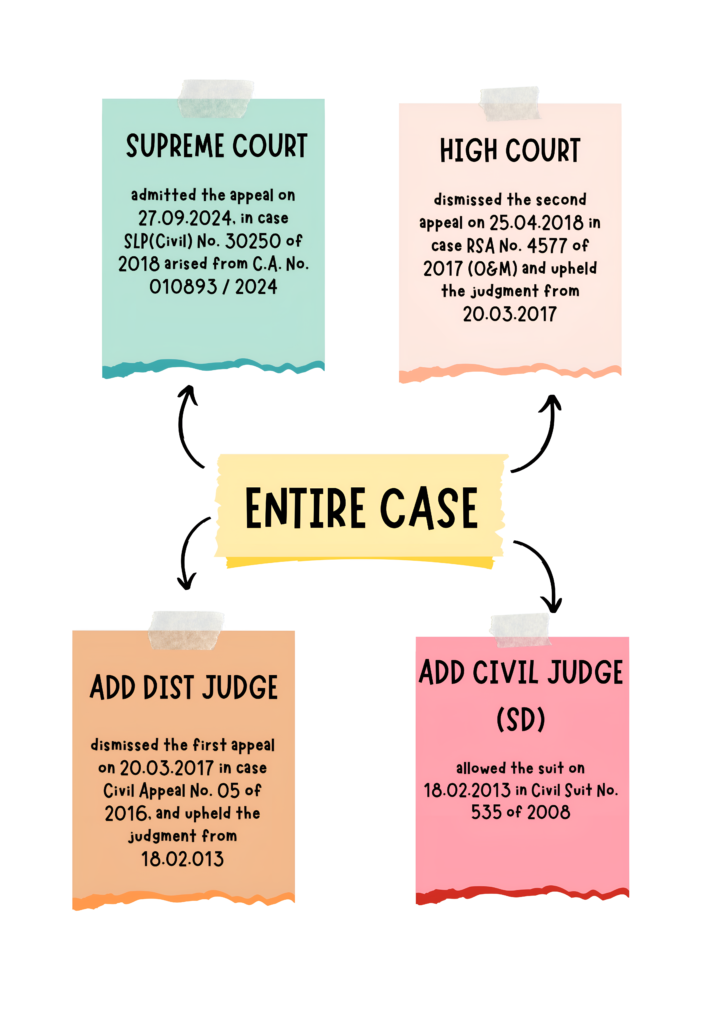
Facts of the Case:
The Plaintiff, Head Constable in the Punjab police, at Amritsar, initiated a suit2 to enforce a sale agreement dated 7th May 2007, concerning an agricultural plot of land measuring 30 Kanals and 8 Marlas3 located in Village Amrike, Punjab.
Under the sale agreement, the parties set the price at Rs. 5,00,000 per Killa4, and the Plaintiff paid a total earnest money of Rs. 16,00,000 to the Defendant upon signing the agreement.
Both parties agreed to execute and register the sale agreement by 19th September 2008, approximately four months later.The sale agreement also had a clause stating that if Defendant Failed to execute the sale agreement, he would incur a penalty of Rs. 32,00,000. Furthermore, even after receiving both, the earnest money and any applicable penalties, the Plaintiff retained his right to file a suit to compel the execution of the sale agreement.
However, when the deadline arrived, the Defendant failed to appear at the Joint Registrar’s office to execute the sale agreement. The Plaintiff subsequently claimed that the Defendant breached the terms of the sale agreement by failing to register it despite several requests. The Plaintiff asserted that he received possession of the land at the time of signing the sale agreement and has maintained it as a prospective buyer. Fearing that the Defendant might sell the land to another party and potentially dispossess him, the Plaintiff filed the said suit seeking legal relief to enforce his rights under the sale agreement.
Arguments:
| Plaintiff | Defendant |
| The Plaintiff contends that the Defendant did not show up at the Registrar’s office to execute the sale agreement, as stipulated in the sale agreement. | The Defendant contends that the sale agreement was fraudulent, claiming his thumb impression was taken on blank papers without his consent. |
| That Plaintiff contends that he paid a significant portion of the purchase price for the plot of land, with the remaining 15% due at the time of registration. | The Defendant denies receiving any money for the land, stating he is not bound by the sale agreement. |
| The Plaintiff contends that the trial court, the First Appellate Court, and the High Court reviewed the evidence thoroughly and concluded that the transaction was a loan, making the Defendant liable to repay the amount. | The Defendant contends that the agreed sale price of Rs. 5,00,000 per Killa is significantly lower than the current market rate of Rs. 12,00,000 per Killa, suggesting the deal was unreasonable. The Defendant emphasizes that the plot of land is his sole source of income, arguing that there would be no logical reason for him to sell it at such a low price. |
| The Plaintiff argues that this case is not fit for interference by the SC under Article 136, which grants the Court discretion to review judgments. He believes that the lower courts have already made a thorough and fair assessment of the evidence. | The Defendant contends that this case warrants interference by the SC under Article 136 due to the alleged fraud and unfair practices involved in the sale agreement. |
Analysis:
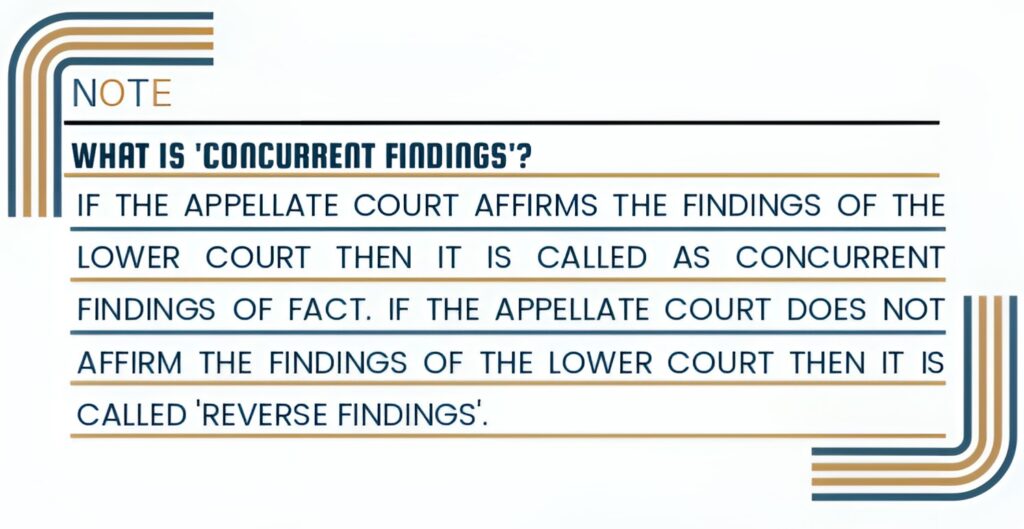
In respect of Article 136 of the of the Constitution of India, SC observed that it grants the SC the power to exercise jurisdiction over appeals by special leave, but this power should only be exercised in cases where the factual findings of lower courts are perverse or where critical evidence has been overlooked. A principle was established in the case of Sukhbiri Devi v. Union of India5, which clarifies the limited scope of appeal against concurrent findings, emphasizing the need for substantial grounds to challenge such findings.
In Mekala Sivaiah v. State of A.P.6, the SC emphasized that its powers under Article 136 are broad and not restricted by technicalities. However, the exceptional power should be exercised cautiously and sparingly, primarily to promote justice.
In Bharwada Bhoginbhai Hirjibhai v. State of Gujarat7, it was held that the Apex Court should not interfere with the concurrent findings of fact unless it is established:
“8.1. That the finding is based on no evidence.
18.2. That the finding is perverse, it being such as no reasonable person could arrive at even if the evidence was taken at its face value.
18.3. The finding is based and built on inadmissible evidence which evidence, excluded from vision, would negate the prosecution case or substantially discredit or impair it.
18.4. Some vital piece of evidence which would tilt the balance in favour of the convict has been overlooked, disregarded or wrongly discarded.“
SC further observed that the stamp papers were purchased by a third party. The thumb impression of the Defendant was only on one page and not on the rest two pages of the sale agreement. The space between the lines of the sale agreement appeared to be adjusted in such a manner that sufficient typing could be taken till the page where the thumb impression of defendant was allegedly taken.
It was further observed that the Plaintiff who was a police constable, being a government official required to obtain necessary departmental permission for such a high-value transaction. However, since the Plaintiff failed to do so, it cast doubt on the legitimacy of the sale agreement. As per the cross examination of the Plaintiff, when asked that whether plaintiff withdrew the sum of earnest money i.e., ₹16,00,000, from his Bank account, the Plaintiff answered in negative. Moreover, the terms of the sale agreement, where the Plaintiff paid a substantial earnest money of ₹16,00,000 (about 85% of the total consideration) while deferring the sale agreement execution for over 16 months, appeared illogical and suspicious to SC.
Furthermore, SC observed that the Plaintiff ‘s actions during this period raised questions about his commitment to the sale agreement, as he did not proactively approach the Defendant for executing the sale agreement before resorting to litigation. The SC’s observations point to a highly questionable nature of the sale agreement, suggesting it does not inspire confidence and merits closer scrutiny.
In its observations, SC found the Plaintiff’s claims to be fundamentally untrue and likely fabricated. The evidence presented suggested that the alleged sale agreement may have been created on a blank stamp paper after the Defendant ‘s thumb impression was taken, given the significant blank spaces and the absence of signatures on the first two pages.
SC pointed out that the Plaintiff did not assert he carried the balance sale consideration when appearing at the Sub-Registrar’s office, nor did he claim to have offered it to the Defendant at any time. The Defendant, who testified in court, denied both the execution of the sale agreement and the receipt of ₹16,00,000 from the Plaintiff. The trial court initially discredited the respondent’s version, interpreting the payment as a loan rather than a sale advance. However, the SC noted that there was no evidence suggesting this amount was intended as a loan during the cross-examination. Overall, the Court’s analysis indicated significant doubt about the validity of the Plaintiff ‘s claims and the authenticity of the disputed sale agreement.
Held:
Relying on the observations and the judgements as mentioned above, SC held as below:
“36. The factors enumerated above, are sufficient for this Court to conclude that the entire case of the respondent-plaintiff regarding the execution of the disputed agreement; the alleged payment of Rs. 16,00,000/- in cash to the appellant-defendant on 7th May, 2007 and the alleged appearance of the respondent-plaintiff in the office of the Sub-Registrar in the purported exercise of getting the sale deed executed in terms of the disputed agreement is nothing but a sheer piece of fraud and concoction.”
“37. These vital factual aspects were totally glossed over by the Courts below while deciding the suit, the first appeal and the second appeal. In these facts and circumstances, we find it to be a fit case to exercise our powers under Article 136 of the Constitution of India so as to interfere with the impugned judgements.”
Case Title: Lakha Singh v. Balwinder Singh & Anr., C.A. No. 010893 / 2024
Citation : 2024 LiveLaw (SC) 755
- Case Title: LAKHA SINGH VERSUS BALWINDER SINGH & ANR., C.A. No. 010893 / 2024 ↩︎
- Civil Suit No. 535 of 2008 [Addl Civil Judge (SD)] ↩︎
- A traditional unit of area that is used in India, Pakistan and Bangladesh. ↩︎
- ibid ↩︎
- 2022 SCC OnLine SC 1322 ↩︎
- (2022) 8 SCC 253. ↩︎
- Ibid, Para 18 ↩︎
About The Author
